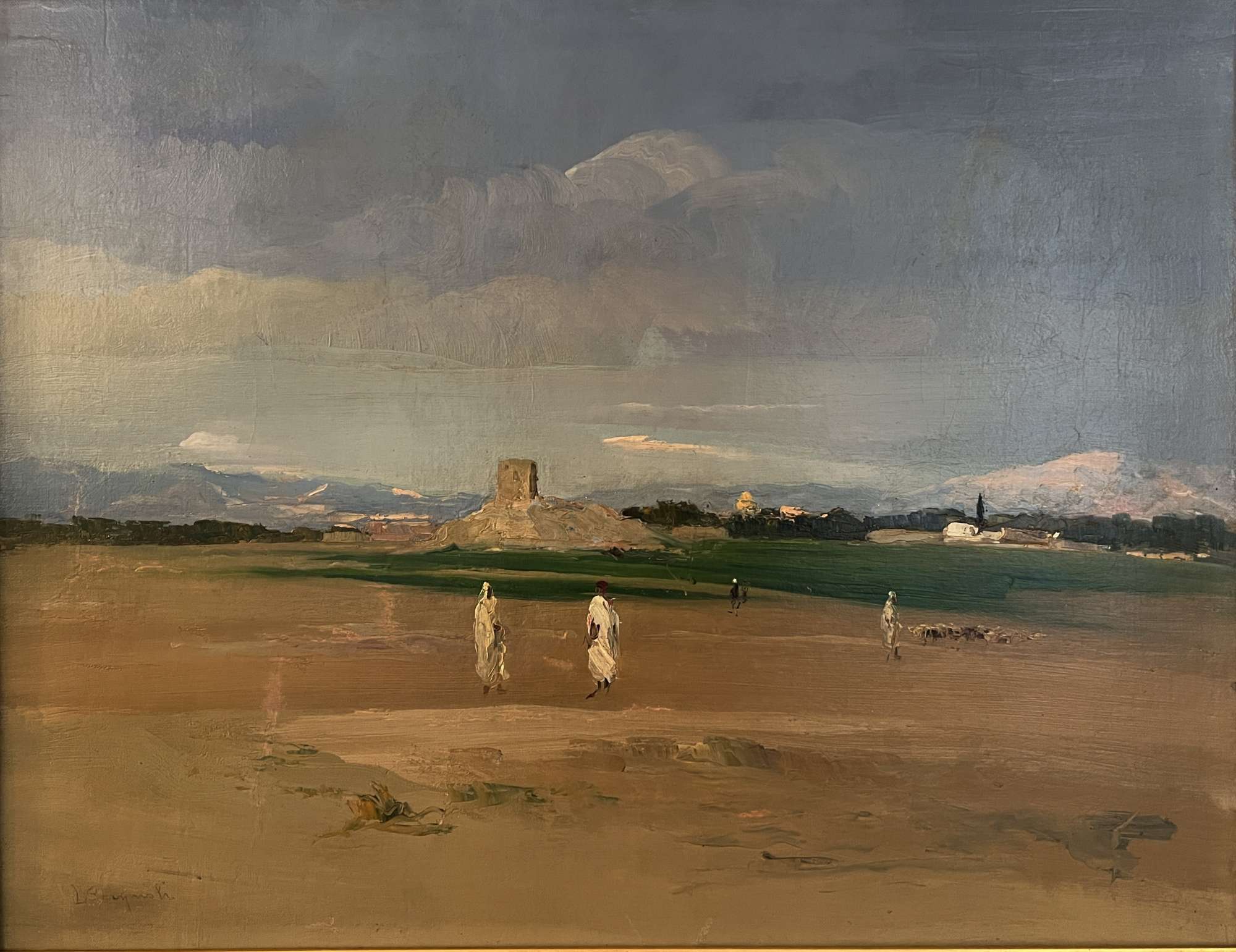
Luigi Brignoli
Palosco, Bg. 1881 - Bergamo, 1952
A disciple of Cesare Tallone and Ponziano Loverini at the Accademia Carrara, at the end of his studies he moved to Milan, with his brother Giacomo, where he attended the courses of Brera and found Tallone, the first master he had in Bergamo. From these masters he learns the naturalism deriving from the Venetian tradition, the observation of nature, the decisive brushstroke, the strong contrasts of light. He took part in several exhibitions at the Accademia Carrara, Brera and the Permanente in Milan. In 1903, a self-portrait was shown at the Royal Academy in London.
In 1905 he was invited to Zurich to paint a series of portraits of the Châffer family. His works were very successful and other acquaintances of the Châffers asked him to work for a large fee. He returned to Italy and moved to Caravaggio. In 1906 he exhibited at the Società Amatori e Cultori in Rome and was admitted to the Venice Biennale for the first time. She has a studio in Milan and in 1910, after her marriage, she settled in the Lombard capital.
In these years he participated in various national and international exhibitions (Buenos Aires and Brussels in 1911 for example) and exhibited in private galleries. His great work, heroic Belgium or Belgium 1914, performed in 1918, was awarded the gold medal by the Ministry of Education and purchased by the consul of Belgium resident in Milan, then destined for the Royal Museum of Brussels.
His adherence to the painting of reality is firmly convinced and sincere, for this reason he remains far from fashions and reactionary tendencies.
His first trip to North Africa was in 1922. He is in fact invited to Biskra (Algeria) by the industrialist from Bergamo Ernesto Rodari who admires the work of Brignoli. The following year a large exhibition of works painted in Africa is held at the Artistic Circle of Bergamo. In December of the same year he returned to Algeria, accompanied by the painter Giorgio Oprandi, while in 1924 he made a long trip to Spain. His ability allowed him to be called to the service of the international aristocracy that frequented Biskra, becoming his official portrait painter. His works also found in his homeland the favor of the fascist regime in search of a colonial empire.
In 1925 he held a solo show at the Galleria Pesaro in Milan, praised by the public and critics.
With this "African" painting, Brignoli represents the initiator of a theme that will make numerous proselytes. Other artists from Bergamo, in fact, fascinated by his travels, leave for North Africa stopping for a long time: Giorgio Oprandi, Ernesto Quarti Marchiò, Romualdo Locatelli. He does not seek the "picturesque", but the "pictorial", is strongly inspired by truth, rendered with synthetic fidelity.
After many successes, in 1928 Brignoli was appointed Professor of the School of Painting of the Accademia Carrara.
Another solo exhibition, in 1932, at the Galleria Permanente in Bergamo, was very successful and the local press dedicated a lot of space to the event. Back from his usual trip to Africa, in 1934 he set up, at the Circolo Artistico Bergamasco, the exhibition entitled Tripolitania that previews some of the latest works made in Tripoli and its surroundings. The success is such that the duration of exposure is extended several times.
In 1939 he was awarded the San Remo Prize, the Livorno Prize, the Bergamo Prize and the following year he published a monograph on the artist, with text by Guido Marangoni.
In 1942 in Milan, in the halls of the Permanente, Brignoli collected the fruit of forty years of work. Also on display is Lekemti, the patriotic composition illustrating the sacrifice of Antonio Locatelli and the heroic companions.
The decade before his death sees the artist constantly at work; his participation in national exhibitions and in galleries is always assiduous.
In 1942 in Milan, in the halls of the Permanente, Brignoli collected the fruit of forty years of work. Also on display is Lekemti, the patriotic composition illustrating the sacrifice of Antonio Locatelli and the heroic companions.
The decade before his death sees the artist constantly at work; his participation in national exhibitions and in galleries is always assiduous.
Among the most important posthumous exhibitions are those organized by Galleria Bolzani in Milan in 1957 and that of 1985 at the Galleria d'Arte Bergamo.
His works are located in the Civic Gallery of Modern Art, in the Palazzo della Provincia, in the picture gallery of the Ospedale Maggiore in Milan; in Bergamo at the Accademia Carrara, in the picture of the Ospedale Maggiore, in the collections of the Banca Provinciale Lombarda, of the Banca Popolare di Bergamo Credito Varesino and the Chamber of Commerce; in Cremona in the picture gallery of the Ospedale Maggiore; in the Royal Museum of Brussels; in the Modern Art Gallery of Algiers; in Biskra at the Modern Art Gallery.
Museums:
Bergamo (Accademia Carrara, quadreria dell'Ospedale Maggiore, collections of the Banca Provinciale Lombarda, Banca Popolare di Bergamo Credito Varesino and the Chamber of Commerce), Italy
Milan (Civic Gallery of Modern Art, Palazzo della Provincia, Quadreria dell'Ospedale Maggiore)
Cremona (picture gallery of the Maggiore Hospital)
Brussels (Royal Museum), Belgium
Algiers (Modern Art Gallery), Algeria
Biskra (Modern Art Gallery), Algeria
Bibliography:
AA.VV.Exhibition catalogue at Galleria Pesaro, Milan, October-November 1926
Geo Renato Crippa, Luigi Brignoli - Strapaesano anteguerra, Bergamo, ED. Sant'Alessandro, 1935
G. Marangoni, Luigi Brignoli, la vita e l'opera, Bergamo, Istituto Italiano d'Arti Grafiche, Editore, 1940
A. M. Comanducci, Dizionario illustrato dei Pittori, Disegnatori e Incisori Italiani Moderni e Contemporanei, Milano, Luigi Patuzzi Editore, 1972
I pittori bergamaschi dell'ottocento, Raccolta di studi a cura della Banca Popolare di Bergamo Credito Varesino, Bergamo, Edizioni Bolis, 1992
From the Orobie to the Maghreb. The Bergamo orientalists. Luigi Brignoli, Romualdo Locatelli, Giorgio Oprandi, Ernesto Quarti Marchiò, E. Accademia Tadini, Lovere (Bg) 1999
Maestri e Artisti, 200 anni della Accademia Carrara, curated by F. Rossi, Milan, Skira Editore, 1996.
In 1905 he was invited to Zurich to paint a series of portraits of the Châffer family. His works were very successful and other acquaintances of the Châffers asked him to work for a large fee. He returned to Italy and moved to Caravaggio. In 1906 he exhibited at the Società Amatori e Cultori in Rome and was admitted to the Venice Biennale for the first time. She has a studio in Milan and in 1910, after her marriage, she settled in the Lombard capital.
In these years he participated in various national and international exhibitions (Buenos Aires and Brussels in 1911 for example) and exhibited in private galleries. His great work, heroic Belgium or Belgium 1914, performed in 1918, was awarded the gold medal by the Ministry of Education and purchased by the consul of Belgium resident in Milan, then destined for the Royal Museum of Brussels.
His adherence to the painting of reality is firmly convinced and sincere, for this reason he remains far from fashions and reactionary tendencies.
His first trip to North Africa was in 1922. He is in fact invited to Biskra (Algeria) by the industrialist from Bergamo Ernesto Rodari who admires the work of Brignoli. The following year a large exhibition of works painted in Africa is held at the Artistic Circle of Bergamo. In December of the same year he returned to Algeria, accompanied by the painter Giorgio Oprandi, while in 1924 he made a long trip to Spain. His ability allowed him to be called to the service of the international aristocracy that frequented Biskra, becoming his official portrait painter. His works also found in his homeland the favor of the fascist regime in search of a colonial empire.
In 1925 he held a solo show at the Galleria Pesaro in Milan, praised by the public and critics.
With this "African" painting, Brignoli represents the initiator of a theme that will make numerous proselytes. Other artists from Bergamo, in fact, fascinated by his travels, leave for North Africa stopping for a long time: Giorgio Oprandi, Ernesto Quarti Marchiò, Romualdo Locatelli. He does not seek the "picturesque", but the "pictorial", is strongly inspired by truth, rendered with synthetic fidelity.
After many successes, in 1928 Brignoli was appointed Professor of the School of Painting of the Accademia Carrara.
Another solo exhibition, in 1932, at the Galleria Permanente in Bergamo, was very successful and the local press dedicated a lot of space to the event. Back from his usual trip to Africa, in 1934 he set up, at the Circolo Artistico Bergamasco, the exhibition entitled Tripolitania that previews some of the latest works made in Tripoli and its surroundings. The success is such that the duration of exposure is extended several times.
In 1939 he was awarded the San Remo Prize, the Livorno Prize, the Bergamo Prize and the following year he published a monograph on the artist, with text by Guido Marangoni.
In 1942 in Milan, in the halls of the Permanente, Brignoli collected the fruit of forty years of work. Also on display is Lekemti, the patriotic composition illustrating the sacrifice of Antonio Locatelli and the heroic companions.
The decade before his death sees the artist constantly at work; his participation in national exhibitions and in galleries is always assiduous.
In 1942 in Milan, in the halls of the Permanente, Brignoli collected the fruit of forty years of work. Also on display is Lekemti, the patriotic composition illustrating the sacrifice of Antonio Locatelli and the heroic companions.
The decade before his death sees the artist constantly at work; his participation in national exhibitions and in galleries is always assiduous.
Among the most important posthumous exhibitions are those organized by Galleria Bolzani in Milan in 1957 and that of 1985 at the Galleria d'Arte Bergamo.
His works are located in the Civic Gallery of Modern Art, in the Palazzo della Provincia, in the picture gallery of the Ospedale Maggiore in Milan; in Bergamo at the Accademia Carrara, in the picture of the Ospedale Maggiore, in the collections of the Banca Provinciale Lombarda, of the Banca Popolare di Bergamo Credito Varesino and the Chamber of Commerce; in Cremona in the picture gallery of the Ospedale Maggiore; in the Royal Museum of Brussels; in the Modern Art Gallery of Algiers; in Biskra at the Modern Art Gallery.
Museums:
Bergamo (Accademia Carrara, quadreria dell'Ospedale Maggiore, collections of the Banca Provinciale Lombarda, Banca Popolare di Bergamo Credito Varesino and the Chamber of Commerce), Italy
Milan (Civic Gallery of Modern Art, Palazzo della Provincia, Quadreria dell'Ospedale Maggiore)
Cremona (picture gallery of the Maggiore Hospital)
Brussels (Royal Museum), Belgium
Algiers (Modern Art Gallery), Algeria
Biskra (Modern Art Gallery), Algeria
Bibliography:
AA.VV.Exhibition catalogue at Galleria Pesaro, Milan, October-November 1926
Geo Renato Crippa, Luigi Brignoli - Strapaesano anteguerra, Bergamo, ED. Sant'Alessandro, 1935
G. Marangoni, Luigi Brignoli, la vita e l'opera, Bergamo, Istituto Italiano d'Arti Grafiche, Editore, 1940
A. M. Comanducci, Dizionario illustrato dei Pittori, Disegnatori e Incisori Italiani Moderni e Contemporanei, Milano, Luigi Patuzzi Editore, 1972
I pittori bergamaschi dell'ottocento, Raccolta di studi a cura della Banca Popolare di Bergamo Credito Varesino, Bergamo, Edizioni Bolis, 1992
From the Orobie to the Maghreb. The Bergamo orientalists. Luigi Brignoli, Romualdo Locatelli, Giorgio Oprandi, Ernesto Quarti Marchiò, E. Accademia Tadini, Lovere (Bg) 1999
Maestri e Artisti, 200 anni della Accademia Carrara, curated by F. Rossi, Milan, Skira Editore, 1996.