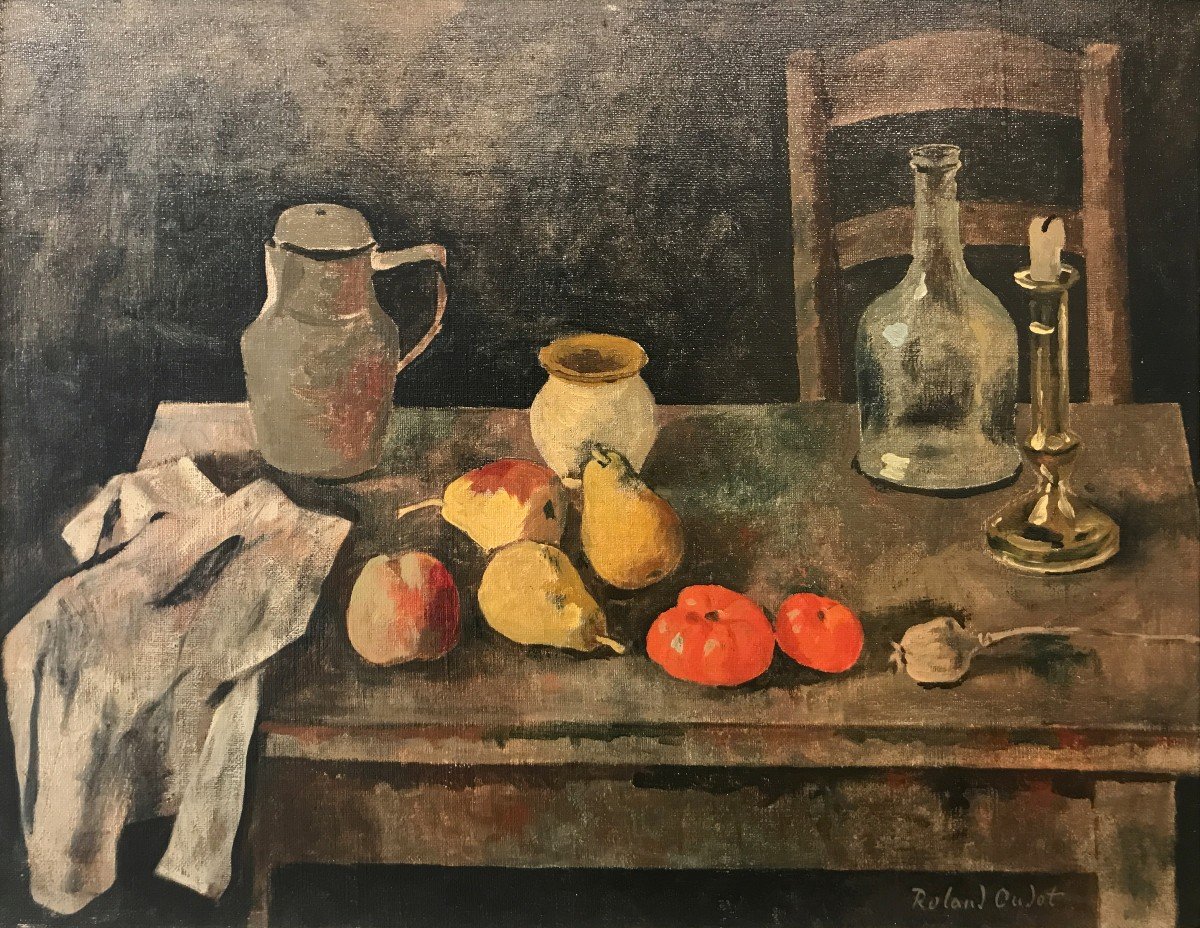
Roland Oudot
Parigi, 1897 - 1981
Oudot belongs to that group of artists who came to prominence between the wars under the name Poetic Reality Painters and are generally regarded as the last Impressionists. Poetic Reality began to form during the years of attendance at the School of Decorative Arts, when a solid friendship was established between Oudot, Maurice Brianchon, and Raymond Legueult. Around this initial trio, fortified by Eugène Morand's teaching of great moral and cultural intensity, the circle of friendships slowly expanded and saw the entry into the group of other artists such as Segonzac, Zahar, Roger-Marx, Fels, Rey, Daulte, Limouse, and Terechovitch.
After graduating from the Lycée Lavoisier, from 1912 to 1915 he studied at the National School of Decorative Arts, in Eugène Morand's Atelier.
Until 1920 he certainly felt the influence of Cezanne, then of Bonnard, which causes his works, marked by stark realism, to evolve toward greater softness. He also looked to Fauvism and Cubism, but without moving away from close contact with nature.
He collaborated with Léon Bakst on the decorations for the Russian Ballets and worked with the master until his death in 1923. Oudot also worked for the famous interior designers Sue et Mare, creating textile and furniture designs.
Initially his interest focused on the landscapes of the Ile de France and then moved to the Basque Country, Spain, and Italy.
Finally, in 1936, he discovered Provence, whose austerity was more in keeping with his temperament, and moved to Saint-Rémy. But the dominant gray is by no means monotonous in his paintings as it helps to tone down the intense blues and reds that are thus lightened.
His compositions attest to sober elegance, a rigorous sense of balance thanks to the pleasing arrangement of the elements. Nature always remains his major source of inspiration.
Soon art lovers and critics of the caliber of Wilhelm Uhde or Louis Vauxelles are impressed by the vigor and classical order of his landscapes, mythological scenes and female figures.
He began to participate in group exhibitions in Paris: from 1919 he was present at the Salon d'Automne, from 1925 at the Salon des Tuileries of which he was a member of the committee; in 1942 he exhibited with Brianchon and Legueult at the Galerie Louis Carré.
From the end of World War II the artist regularly returned to Provence where, from the terrace of his Eygalières mansion, he never tired of drawing the area's rolling hills.
In 1954 Oudot bought the old manor house at Vasouy, near Honfleur where he spent every summer painting the beaches and meadows of Normandy.
From 1954 to 1959 and again in 1963 he exhibited at the Galerie Charpentier and regularly at the Salon des Peintres Temoins de leur Temps.
Exhibitions abroad include: in 1924 the exhibition with Brianchon at the Palais des Beaux-Arts in Brussels; in 1957 the exhibition of the Painters of Poetic Reality at Tour de Peilz in Switzerland and also numerous solo exhibitions in Paris, New York, London, Zurich, Basel, and Geneva.
In his later years the artist stayed in Greece, New York and often in Venice.
Oudot belongs to that group of artists who came to prominence between the wars under the name Poetic Reality Painters and are generally regarded as the last Impressionists. Poetic Reality began to form during the years of attendance at the School of Decorative Arts, when a solid friendship was established between Oudot, Maurice Brianchon, and Raymond Legueult. Around this initial trio, fortified by Eugène Morand's teaching of great moral and cultural intensity, the circle of friendships slowly expanded and saw the entry into the group of other artists such as Segonzac, Zahar, Roger-Marx, Fels, Rey, Daulte, Limouse, and Terechovitch.
This painting is a hymn to happiness, perhaps to forget the hard years of World War I that marked the best years of these artists' youth.
Bibliography:
Les Peintres de la realité poetique, Galerie J.P. Joubert, Paris, 1987; F. Daulte, Les peintres de la Réalité Poetique, La bibliotheque des Arts, Lausanne, Paris, 1994
© Roland Oudot, by SIAE 2023
Until 1920 he certainly felt the influence of Cezanne, then of Bonnard, which causes his works, marked by stark realism, to evolve toward greater softness. He also looked to Fauvism and Cubism, but without moving away from close contact with nature.
He collaborated with Léon Bakst on the decorations for the Russian Ballets and worked with the master until his death in 1923. Oudot also worked for the famous interior designers Sue et Mare, creating textile and furniture designs.
Initially his interest focused on the landscapes of the Ile de France and then moved to the Basque Country, Spain, and Italy.
Finally, in 1936, he discovered Provence, whose austerity was more in keeping with his temperament, and moved to Saint-Rémy. But the dominant gray is by no means monotonous in his paintings as it helps to tone down the intense blues and reds that are thus lightened.
His compositions attest to sober elegance, a rigorous sense of balance thanks to the pleasing arrangement of the elements. Nature always remains his major source of inspiration.
Soon art lovers and critics of the caliber of Wilhelm Uhde or Louis Vauxelles are impressed by the vigor and classical order of his landscapes, mythological scenes and female figures.
He began to participate in group exhibitions in Paris: from 1919 he was present at the Salon d'Automne, from 1925 at the Salon des Tuileries of which he was a member of the committee; in 1942 he exhibited with Brianchon and Legueult at the Galerie Louis Carré.
From the end of World War II the artist regularly returned to Provence where, from the terrace of his Eygalières mansion, he never tired of drawing the area's rolling hills.
In 1954 Oudot bought the old manor house at Vasouy, near Honfleur where he spent every summer painting the beaches and meadows of Normandy.
From 1954 to 1959 and again in 1963 he exhibited at the Galerie Charpentier and regularly at the Salon des Peintres Temoins de leur Temps.
Exhibitions abroad include: in 1924 the exhibition with Brianchon at the Palais des Beaux-Arts in Brussels; in 1957 the exhibition of the Painters of Poetic Reality at Tour de Peilz in Switzerland and also numerous solo exhibitions in Paris, New York, London, Zurich, Basel, and Geneva.
In his later years the artist stayed in Greece, New York and often in Venice.
Oudot belongs to that group of artists who came to prominence between the wars under the name Poetic Reality Painters and are generally regarded as the last Impressionists. Poetic Reality began to form during the years of attendance at the School of Decorative Arts, when a solid friendship was established between Oudot, Maurice Brianchon, and Raymond Legueult. Around this initial trio, fortified by Eugène Morand's teaching of great moral and cultural intensity, the circle of friendships slowly expanded and saw the entry into the group of other artists such as Segonzac, Zahar, Roger-Marx, Fels, Rey, Daulte, Limouse, and Terechovitch.
This painting is a hymn to happiness, perhaps to forget the hard years of World War I that marked the best years of these artists' youth.
Bibliography:
Les Peintres de la realité poetique, Galerie J.P. Joubert, Paris, 1987; F. Daulte, Les peintres de la Réalité Poetique, La bibliotheque des Arts, Lausanne, Paris, 1994
© Roland Oudot, by SIAE 2023