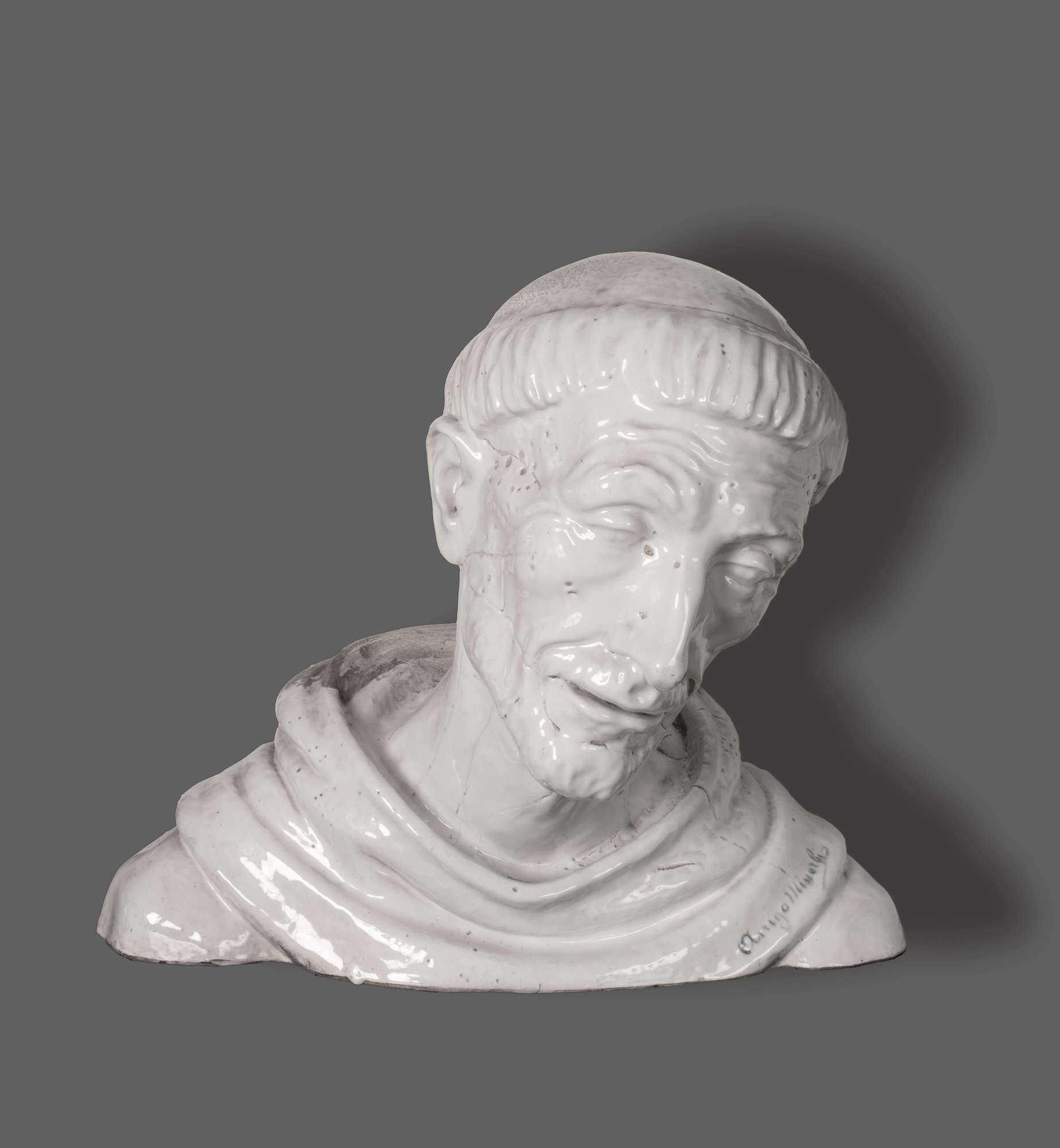
Arrigo Minerbi
Ferrara, 1881 - Padova, 1960
Under the guidance of sculptor Luigi Legnani, he attended an Arts and Crafts course in Ferrara at the Dosso Dossi school. After working as a ceramist, decorator, moulder and plasterer in Ferrara, Florence (where he perfected his skills at the Academy of Fine Arts) and Genoa, he moved, by then 35 years old, to Milan where, in 1919, he revealed himself to critics and the public with a personal exhibition at the Galleria Pesaro.
After the Milan exhibition, his success was renewed in 1920 at the Ferrara Regional and, in 1921, again in Milan. In 1922, Minerbi exhibited at the Primaverile Fiorentina and later, as a guest, at the Venice Biennale where he showed The Last Supper (or Cenacolo), a life-size silver group, which has been placed in Oslo Cathedral since 1950 following a generous bequest. In order to fulfil the numerous commissions, Minerbi was forced to request the collaboration of various sculptors, favouring above all those of Ferrarese origin, including Marco Bisi (son of the artist Adriana Bisi Fabbri), Giuseppe Virgili and Gino Colognesi. After the war, it was the turn of Bergamo sculptor Piero Brolis.
On 14 June 1925, La Madre, a monument to the fallen of the First World War was unveiled in the Parco delle Rimembranze in Bondeno, for which Minerbi was later awarded honorary citizenship of the municipality. Following the promulgation of racial laws in 1938, the honour was revoked and only recognised again in 2004.
He was a favourite artist of Gabriele D'Annunzio, who befriended him and whose marble death mask he executed in 1938. For him he created the portrait of his mother Luisa and the bust of Eleonora Duse, both exhibited at the Vittoriale degli Italiani in Gardone Riviera. Also at the Vittoriale is a bronze cast of Vittoria del Piave, donated to D'Annunzio in 1935 by the City of Milan. Other previous copies of this work are known, one from 1923, destined for the War Memorial in Cuggiono (Milan) and another from 1928 for the Victory Tower in Ferrara.
In 1937, he was commissioned by Archbishop Schuster of Milan to create the first, from the left, of the five bronze doors of Milan Cathedral (on the theme of The Edict of Constantine). The door was only completed in 1948 because the sculptor, in order to escape the consequences of the anti-Semitic laws, was forced to hide in Gavazzana, in the province of Alessandria, in the paternal home of Don Carlo Sterpi (later to become a museum), and in Rome in the Orione San Filippo Neri college.
After the Second World War, Minerbi worked mainly for Catholic churches and cemeteries (in Milan, Rome, Rapallo, Piacenza, Padua and Copparo), finally taking the decision to be baptised in May 1956 in Milan at the church of S. Alessandro, probably at the suggestion of his wife Malvina Benini, a fervent Catholic.
After the Milan exhibition, his success was renewed in 1920 at the Ferrara Regional and, in 1921, again in Milan. In 1922, Minerbi exhibited at the Primaverile Fiorentina and later, as a guest, at the Venice Biennale where he showed The Last Supper (or Cenacolo), a life-size silver group, which has been placed in Oslo Cathedral since 1950 following a generous bequest. In order to fulfil the numerous commissions, Minerbi was forced to request the collaboration of various sculptors, favouring above all those of Ferrarese origin, including Marco Bisi (son of the artist Adriana Bisi Fabbri), Giuseppe Virgili and Gino Colognesi. After the war, it was the turn of Bergamo sculptor Piero Brolis.
On 14 June 1925, La Madre, a monument to the fallen of the First World War was unveiled in the Parco delle Rimembranze in Bondeno, for which Minerbi was later awarded honorary citizenship of the municipality. Following the promulgation of racial laws in 1938, the honour was revoked and only recognised again in 2004.
He was a favourite artist of Gabriele D'Annunzio, who befriended him and whose marble death mask he executed in 1938. For him he created the portrait of his mother Luisa and the bust of Eleonora Duse, both exhibited at the Vittoriale degli Italiani in Gardone Riviera. Also at the Vittoriale is a bronze cast of Vittoria del Piave, donated to D'Annunzio in 1935 by the City of Milan. Other previous copies of this work are known, one from 1923, destined for the War Memorial in Cuggiono (Milan) and another from 1928 for the Victory Tower in Ferrara.
In 1937, he was commissioned by Archbishop Schuster of Milan to create the first, from the left, of the five bronze doors of Milan Cathedral (on the theme of The Edict of Constantine). The door was only completed in 1948 because the sculptor, in order to escape the consequences of the anti-Semitic laws, was forced to hide in Gavazzana, in the province of Alessandria, in the paternal home of Don Carlo Sterpi (later to become a museum), and in Rome in the Orione San Filippo Neri college.
After the Second World War, Minerbi worked mainly for Catholic churches and cemeteries (in Milan, Rome, Rapallo, Piacenza, Padua and Copparo), finally taking the decision to be baptised in May 1956 in Milan at the church of S. Alessandro, probably at the suggestion of his wife Malvina Benini, a fervent Catholic.